
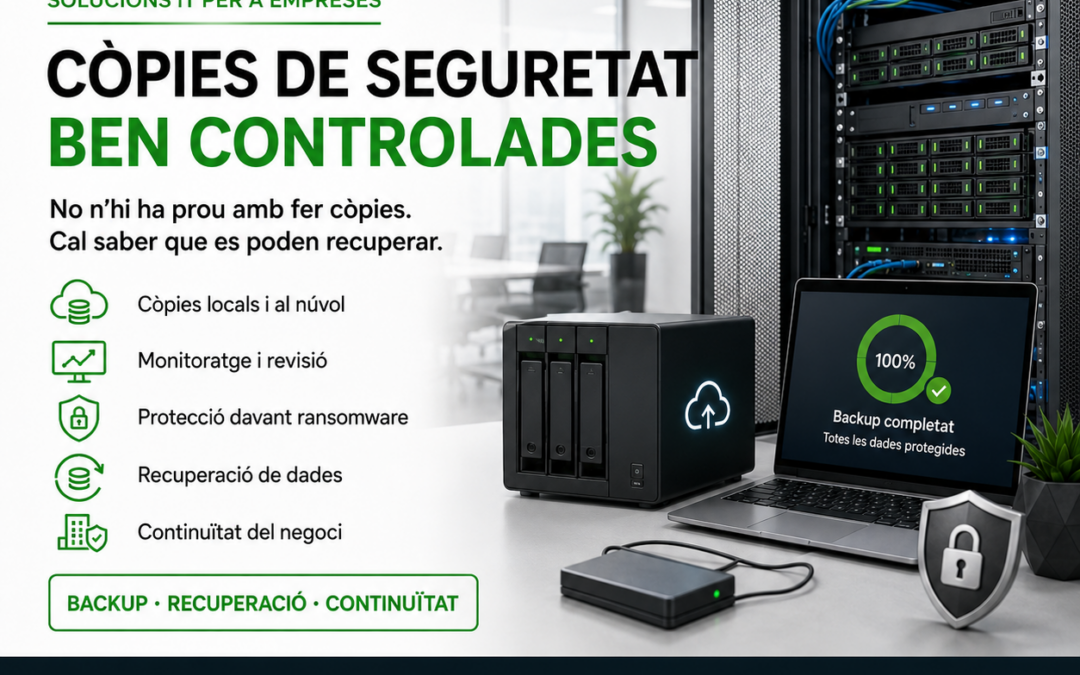
Making backups is important, but it’s not enough. What matters most is knowing that those backups are reviewed, that they work correctly, and that they can be restored when the company truly needs them.
In many companies, backups exist, but nobody checks them regularly. And the problem appears when an incident occurs: a computer that fails, a server that stops responding, a file deleted by mistake or, in the worst-case scenario, a ransomware attack.
At R-Systems Girona we help companies build a well‑designed, controlled backup strategy focused on ensuring business continuity.
Having a backup is not enough
A backup is only useful if it can be restored. That’s why, when we talk about business backups, we don’t just look at whether data is being copied, but also how those copies are made, where they are stored, how often they are reviewed, and how long it will take the company to recover if something happens.
A company may have backups configured for a long time and still discover too late that they weren’t completing correctly, that important folders were missing, or that recovery is much slower than expected.
To avoid this, it’s essential to work with a well‑documented, monitored backup system adapted to the reality of each business.
What should a good backup strategy include?
Local backups and cloud backups
Combining local backups with cloud backups provides greater flexibility and security. Local backups allow quick recovery from day‑to‑day incidents, while external or cloud backups add an extra layer of protection against theft, major failures, fires or attacks affecting the main infrastructure.
Reviews and monitoring
A backup system should not be configured and forgotten. It must be checked to ensure backups complete correctly, that there are no recurring errors, and that the volume of protected data is accurate.
Monitoring allows problems to be detected before it’s too late and enables preventive action.
Recovery tests
The most important test of a backup system is recovery. It’s not enough to see a backup task marked as successful: you must verify that files, folders, virtual machines or systems can be restored when needed.
This point is key to knowing whether the company is truly protected.
Protection against ransomware
Ransomware attacks can encrypt files, block systems and leave a company without access to its information. In these cases, having well‑protected backups can make the difference between a controlled recovery and a serious business interruption.
That’s why it’s important that backups are not exposed in any way and that they form part of a global cybersecurity strategy for companies.
What data should a company protect?
Every company is different, but there is usually information that is critical for business operations. Before configuring a backup system, it’s necessary to identify what is important and what would happen if it were lost.
- Work documents: shared folders, internal documents, budgets, contracts and administrative files.
- Email: corporate mailboxes, communication history and data linked to email.
- Databases: information from management software, ERP, CRM, POS or internal applications.
- Servers: virtual machines, configurations, users, permissions and critical services.
- Key devices: computers with sensitive information or essential workstations.
Recovery is as important as the backup
When a company suffers an incident, what it needs is not to know that “there was a backup”, but to be able to return to work as soon as possible. That’s why a good backup strategy must consider recovery time.
Recovering a deleted file is not the same as restoring an entire server. Recovering a few folders is not the same as bringing an entire environment back online after a major failure.
At R-Systems Girona we help define this scenario so the company knows what to expect and what level of protection it needs.
Backups and business continuity
Backups are part of business continuity. This means they should not be seen as an isolated technical task, but as a measure to prevent an IT incident from stopping the company’s activity.
Good planning helps reduce risks, minimise downtime and establish an action plan when something fails.
Questions every company should ask itself
- Do we know exactly what data is being backed up?
- Do we know how often backups are performed?
- Do we have backups outside the main infrastructure?
- Have recovery tests been performed recently?
- How long can we remain stopped if a server fails or data is lost?
- Are backups protected against ransomware?
How we manage backups at R-Systems Girona
Our approach is practical: review the current situation, detect risks, propose improvements and leave a backup system that can be controlled and maintained over time.
We can help you review existing backups, configure new backup systems, protect servers, NAS devices, computers and cloud environments, and establish a review and recovery policy tailored to your company.
In addition, we integrate this part with other technological services such as IT maintenance for companies, security, IT infrastructure and technical support.
Do you want to know if your company’s backups are properly controlled?
If you’re not sure whether your backups work correctly, if nobody has reviewed them for a long time, or if you don’t know how long it would take to recover data in case of an incident, now is a good time to check.
At R-Systems Girona we can review the current situation, detect weak points and propose a backup solution tailored to your business.
Do you need to review your company’s backups?
Contact us and we’ll help you protect your data, reduce risks and ensure business continuity.


