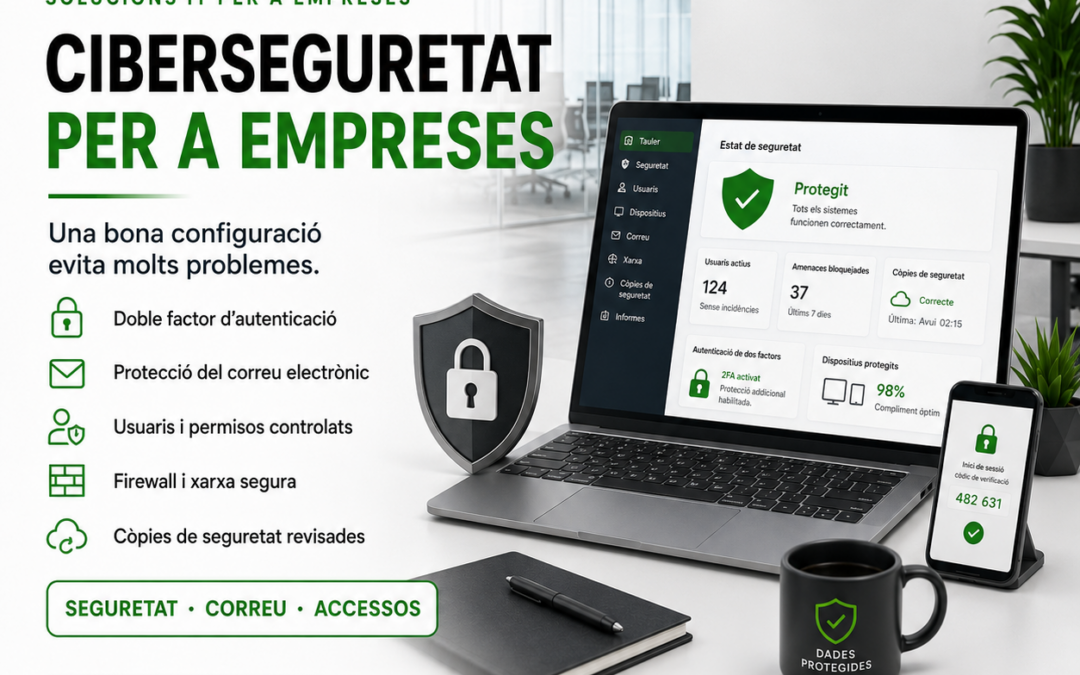
Cybersecurity is no longer just a concern for large companies. Any business that works with email, customer data, invoices, management software, connected computers or cloud services needs a minimum level of protection against digital risks.
Many incidents do not start with a sophisticated attack, but with a weak password, a fraudulent email, a user without two‑factor authentication, a computer without maintenance or a backup that nobody checks.
At R-Systems Girona we help companies improve their IT security with practical, realistic measures adapted to their daily operations.
Cybersecurity starts with email
Email is one of the main entry points for IT problems. Phishing attempts, malicious files, fraudulent links, identity spoofing or messages designed to trick users can all arrive through email.
This is why protecting corporate email is one of the first measures any company should review.
Basic measures to protect email
- Enable two‑step verification on critical accounts.
- Correctly configure SPF, DKIM and DMARC on the domain.
- Review old users or accounts that are no longer used.
- Avoid repeated or overly simple passwords.
- Train users to detect suspicious emails.
- Apply security filters depending on the email environment used.
Two‑factor authentication is essential
A password can be stolen, reused or discovered. That’s why two‑factor authentication, also known as MFA, is one of the most important measures to protect business accounts.
With MFA, even if someone obtains a password, they still need a second verification step to access the account. This greatly reduces the risk of unauthorized access.
It is especially important to enable it on email accounts, admin accounts, Microsoft 365, Google Workspace, management tools, cloud services and any platform containing sensitive data.
Backups: the last line of defense
Backups are an essential part of any cybersecurity strategy. In the event of a failure, human error or ransomware attack, being able to recover data can be the difference between a controlled incident and a serious business interruption.
But having backups is not enough. You must know what is being backed up, where it is stored, how often it is reviewed and whether it can actually be restored.
This point is directly related to a solid business backup strategy.
Questions to ask about backups
- Do we know which data is protected?
- Are there local and external backups?
- Are backups protected against ransomware?
- Have recovery tests been performed?
- Do we know how long it would take for the company to resume operations?
Firewall, network and access
Security also depends on how the company’s network is configured. A properly configured firewall, separated networks, controlled VPN and reviewed permissions can prevent many risks.
On the other hand, an improvised network without segmentation and with uncontrolled devices can expose the company to incidents that are difficult to detect.
Important aspects to review
- Firewall: rules, open ports, remote access and VPN.
- WiFi: separation between internal network and guest network.
- Users: correct permissions according to each person’s role.
- Devices: computers, servers, NAS, printers and connected equipment.
- Updates: operating systems, firmware and critical applications.
Business antivirus and device protection
Computers remain a critical part of security. A device that is outdated, unprotected or running obsolete software can become a weak point for the entire company.
A business antivirus solution, together with maintenance policies, updates and device reviews, helps reduce risks and detect suspicious behavior.
It is also important to review laptops, devices that leave the office, users with remote access and equipment that works outside the main network.
Permissions and users: who has access to what?
A very important part of cybersecurity is reviewing permissions. Over the years, users often accumulate access they no longer need: shared folders, applications, mailboxes, groups, admin permissions or access to old services.
This can be a risk. The fewer unnecessary permissions a user has, the lower the impact if their account is compromised.
What should be reviewed periodically?
- Active users and old users.
- Administrator accounts.
- Permissions on shared folders.
- Access to shared mailboxes.
- Microsoft 365 or Google Workspace groups.
- External applications connected to the account.
User training
Technology is important, but people are also part of security. Many attacks try to trick users into clicking a link, opening a file or entering their password on a fake page.
This is why a more secure company also needs users who are more aware of risks.
Some basic day‑to‑day tips
- Do not open unexpected files without verifying the source.
- Be suspicious of urgent messages requesting payments or passwords.
- Check the sender’s real address.
- Do not reuse passwords across services.
- Report suspicious emails quickly.
Cybersecurity for SMEs: realistic measures
Not all companies need the same level of security, but all should have minimum foundations. The most important thing is to start with realistic and maintainable measures.
In many cases, a well‑done review can detect important risk points and apply improvements without needing large projects.
- Enable MFA on main accounts.
- Review permissions and old users.
- Correctly configure the email domain.
- Perform and review backups.
- Update devices and systems.
- Organize firewall, network and remote access.
- Apply protection to work devices.
How we help at R-Systems Girona
At R-Systems Girona we review the company’s IT security from a practical perspective: email, users, permissions, devices, network, backups, access and critical systems.
The goal is to detect risks, prioritize improvements and apply measures that truly help protect the company.
This service can be integrated into IT maintenance for companies, infrastructure review, backups and ongoing technical support.
Do you want to review your company’s cybersecurity?
If it has been a while since you reviewed passwords, backups, permissions, devices, email or remote access, it may be a good time for an assessment.
At R-Systems Girona we can help you detect weak points and apply security measures adapted to your company’s reality.
Need to improve your business’s IT security?
Contact us and we will review email, backups, users, permissions, network and critical systems together.


