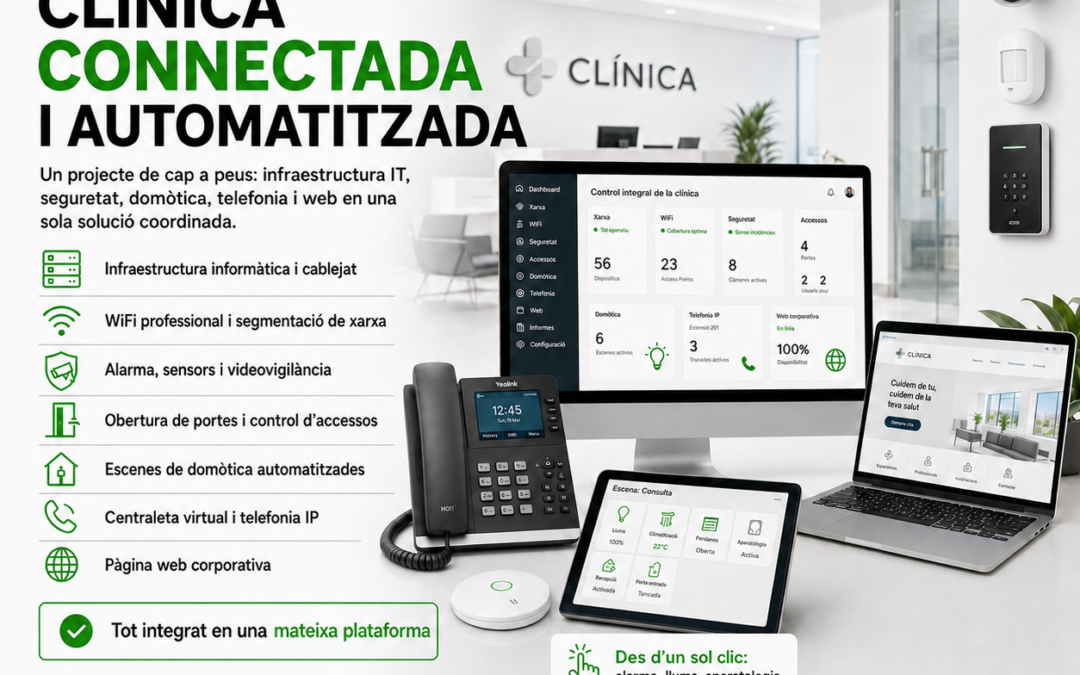
When a clinic or professional center opens, is renovated or wants to modernize, technology must be well planned from the beginning. It’s not just about installing computers or an Internet connection, but about coordinating IT infrastructure, network, WiFi, security, telephony, automation and digital presence in a single project.
A connected clinic needs to work with stable, secure systems prepared for day‑to‑day operations: reception, rooms, offices, work equipment, diagnostic systems, cameras, alarm, telephony and corporate website.
At R-Systems Girona we help clinics, professional centers and service companies design integral technological projects, avoiding improvisation and ensuring every part fits with the rest.
What does it mean to create an integral technological project?
An integral technological project is one in which all components are planned together. The network is not handled separately from telephony, the alarm or the website. Everything is part of the same ecosystem.
This allows better infrastructure design, avoids duplication, reduces errors and simplifies future maintenance.
In a clinic, this coordination is especially important because there are many areas, devices and different needs: reception, consultation rooms, offices, medical equipment, TVs, cameras, access control, WiFi and communications.
IT infrastructure and cabling
The foundation of any connected clinic is a well‑designed IT infrastructure. Cabling, rack, network points, switches and device interconnection must be planned before the center is operational.
Poor planning can cause coverage issues, improvised cabling, devices without stable connection or difficulties expanding the installation later.
What should be considered?
- Network points: reception, rooms, offices, auxiliary equipment and technical areas.
- Centralized rack: location, power, ventilation and cable organization.
- Proper switches: capacity, PoE if needed, segmentation and growth margin.
- Cable identification: clear labeling to simplify maintenance and troubleshooting.
- Future planning: new workstations, cameras, WiFi points or additional devices.
Professional WiFi and network segmentation
A clinic’s WiFi cannot depend on a home router or a single access point. Stable coverage must be guaranteed in all necessary areas and usage must be properly separated.
A clinic may need staff network, guest WiFi, internal device connectivity, IP telephony, cameras or specific equipment. That’s why network segmentation is important.
Advantages of professional WiFi
- Better coverage in reception, rooms and work areas.
- Separation between internal network and guests.
- More stability with multiple connected devices.
- Centralized management of access points.
- Better control and security of the infrastructure.
Security, alarm and video surveillance
Physical and digital security are also part of the technological project. A clinic may need integrated alarm, sensors, video surveillance cameras, access control and notification systems.
These elements must be planned together with the network, electrical supply, cabling and device placement.
Common elements in a security project
- Alarm: sensors, keypads, sirens and alert communication.
- Cameras: access control, hallways, reception or sensitive areas.
- Access control: doors, codes, cards or automated systems.
- Segmentation: separating security devices from other networks.
- Secure remote access: monitoring or management when needed.
IP telephony and virtual PBX
Telephony is a critical part of a clinic. Reception, appointments, patient calls, forwarding and schedules must be well organized.
A virtual PBX and IP telephony solution allows better call management, extension creation, schedule configuration, custom messages and improved internal communication.
Useful features for a clinic
- Extensions for reception, offices or managers.
- Welcome message.
- Opening and closing schedule.
- Call forwarding.
- Call queues or groups.
- Possibility of using IP phones or softphones.
Automation and access control
Some projects may also include automation: door opening, smart scenes, lighting control, blinds, climate control or automatic alerts.
Not all clinics need the same level of automation, but when properly planned it can improve comfort, security and efficiency.
The most important thing is that these automations are well integrated and easy to manage.
Corporate website and digital presence
A technological project may also include the external digital part: corporate website, service information, contact details, forms, local positioning and professional image.
In a clinic, the website is often the first point of contact with the patient. It must convey trust, clearly explain services and make it easy for users to contact or request information.
At R-Systems Girona we also develop corporate websites and digital projects tailored to each company.
Why is it important to coordinate everything from the beginning?
When each part of the project is handled by a different provider without coordination, problems may appear: missing network points, poorly placed devices, incompatibilities, duplicated costs, improvised cabling or systems that cannot be properly managed.
In contrast, when global planning is done, every decision makes more sense: where to place the rack, how many network points are needed, which areas require WiFi, how telephony will work, where cameras will be installed and how maintenance will be handled.
- Less improvisation: everything is planned before installation.
- More order: cabling, rack, devices and systems well documented.
- More security: separated networks, controlled access and protected equipment.
- More efficiency: fewer duplications and better coordination between services.
- Easier maintenance: any issue can be resolved more quickly.
A single technological partner for the project
The great advantage of working with a single technological partner is having a global vision. Not only focusing on one component, but on how the entire project fits together.
At R-Systems Girona we can coordinate IT infrastructure, network, WiFi, security, telephony, web and ongoing support. This gives the company a clear technical interlocutor and a more coherent installation.
This approach aligns with our way of working as a technological partner for companies.
How do we work on a project like this?
1. We analyze the space and needs
We review plans, work areas, critical points, number of users, devices, network needs, telephony, security and web.
2. We define the infrastructure
We plan network points, rack, WiFi, switches, cabling, telephony, cameras, alarm and other necessary elements.
3. We coordinate the implementation
We prepare the installation, configure the equipment and validate that each service works correctly.
4. We provide ongoing support
Once the center is operational, we offer technical support, maintenance, adjustments and project evolution if the company grows or needs change.
Do you want to prepare an integral technological project?
If you are opening a clinic, renovating a center or want to modernize your current infrastructure, it’s important to review the technological part before it’s too late.
At R-Systems Girona we can help you define an integral solution with network, WiFi, security, telephony, automation, web and technical support.
Do you need a well‑coordinated technological project?
Contact us and we will help you plan the technology of your clinic or company from the beginning.


